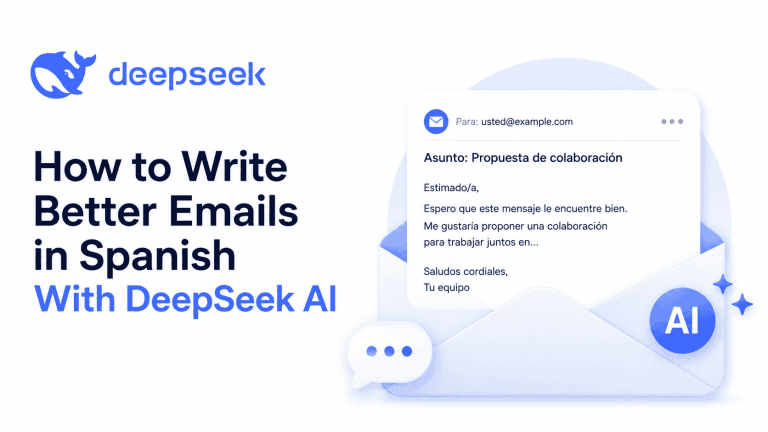
99%的人用 AI 写西班牙语邮件,都犯了同一个错误:只丢一句“翻译成西班牙语”就完事。结果不是太生硬,就是太随便,还可能踩到礼貌和文化的雷区。想让 DeepSeek 真正帮你省时间,而不是制造新问题,你得像给真人编辑写说明书一样,把背景、关系和目标说清楚。
把 DeepSeek 当成“西班牙语写作助理”,而不是“无脑复制粘贴翻译器”。你可以让它起草、翻译、改写、润色、检查语法,但每一封重要邮件,都需要你做最后那一道人工把关。
快速结论: 想用 DeepSeek 写出更好的西班牙语邮件,先用英文说明收件人是谁、你和对方的关系、正式程度、目标、希望使用的西语地区(西班牙/墨西哥/拉美/中性商务西语),再让 DeepSeek起草。之后重点检查语气、事实、姓名、日期、附件和隐私信息。
为什么 DeepSeek AI 特别适合写西班牙语邮件
不只是翻译,而是“重写一封合适的邮件”
很多人以为“把英文翻成西班牙语”就够了,其实专业邮件更在意的是称呼、礼貌程度、句式和结尾。直接逐字翻译“Hope this email finds you well”之类的句子,常常显得别扭甚至多余。
DeepSeek 的优势在于,它能把你零散的英文笔记,整理成结构完整的西班牙语邮件,还能根据不同场景调整语气:给客户更正式,给同事更温暖,给客服用户更简洁直接。有用户反馈,用了类似工作流后,写一封西语商务邮件的时间从20分钟降到5分钟左右。
你可以用 DeepSeek 来:
- 根据几条英文要点起草一封完整邮件
- 翻译英文邮件成西班牙语,同时保留原本的礼貌和语气
- 把你写得生硬的西语草稿改得更自然
- 让邮件变得更正式、更友好、更直接或更委婉
- 检查语法、拼写和表达是否清晰
- 调整为西班牙、西语美洲、墨西哥或“中性商务西语”
- 一次性生成主题、正文、英文翻译和语气说明
我自己试过几次,把很“中式英文”的说明丢给 DeepSeek,它能自动帮我拆成短段落、加上合适的问候和结尾,看起来就像一封真正的商务邮件,而不是翻译软件拼出来的句子。
什么样的西班牙语邮件才算“专业”
据塞万提斯学院的写作指南,一封标准的西班牙语商务邮件通常包含五个部分:
- 清晰的主题
- 合适的称呼
- 简短的开头句
- 集中、礼貌的正文
- 得体的结尾和署名
最关键的选择是“用 usted 还是 tú”。在大多数正式或初次联系的场景里,用 usted 会更安全。不同国家、公司文化、年龄层会有差异,但第一次发邮件给对方时,偏正式通常更稳妥。
很多英文客套话直译过去会显得奇怪,比如:
更自然的开头示例:
Espero que se encuentre bien.
I hope you are well.
另一种专业但简洁的说法:
Espero que todo vaya bien.
I hope everything is going well.
专业邮件还要“好扫一眼就懂”:段落短一点,句子不要太长,一段里只放一个清晰的请求或信息点。
示例结构:
Asunto(主题): Solicitud de información sobre la propuesta
Saludo: Estimada Sra. López:
开头: Espero que se encuentre bien.
正文: Le escribo para solicitar más información sobre la propuesta enviada el lunes.
结尾句: Quedo atento/a a sus comentarios.
署名: Saludos cordiales,
细节也很重要。西班牙皇家语言学院(RAE)建议,西语邮件的称呼后面用冒号,比如“Estimado Sr. López:”或“Hola, Ana:”。网上有不少用逗号的例子,但在正式场合,冒号更保险。
用 DeepSeek 写西语邮件的 6 步工作流
1. 先说清楚收件人是谁、什么关系
别让 DeepSeek 自己猜。你可以这样描述收件人:
- 墨西哥的新客户
- 西班牙的一位教授
- 哥伦比亚的一位客服用户
- 一家西语公司的招聘负责人
- 从未联系过的供应商
再补充你和对方的关系:
- 正式的首次联系
- 已合作一段时间的商务伙伴
- 关系友好的同事
- 投诉中的客户
- 学术联系对象
- 潜在销售线索
有一次我只写了“a client”,DeepSeek 给出的语气偏冷。后来改成“long-term client, we have a friendly relationship”,语气立刻柔和很多,这种差别挺明显的。
2. 选定西班牙语变体
西班牙语在不同地区差别不小,用词和礼貌习惯都不完全一样。你可以直接指定:
- 西班牙西班牙语
- 墨西哥西班牙语
- 拉丁美洲西班牙语
- 中性商务西班牙语
如果你也拿不准,就让 DeepSeek 用中性商务西班牙语,一般对跨国业务来说足够稳妥。
3. 用简单英文说明“这封邮件要干嘛”
你不需要先自己写一版西语草稿,只要把目标讲清楚就行。用最简单的英文描述:
“I need to ask a supplier if they can send the updated invoice and confirm the delivery date for order 2458.”
DeepSeek 会根据这个目标,帮你补上合适的称呼、礼貌表达和结构。
4. 带着“限制条件”让 DeepSeek 起草
直接说“Write an email in Spanish”太模糊。可以加上一些具体要求:
- 控制在 150 词以内
- 语气正式但有温度
- 必须包含主题行
- 不要太强势或咄咄逼人
- 全程使用 usted
- 附带英文翻译
这种“带约束”的提示词,会让输出更接近你真正想要的版本,也方便你直接复制到邮箱里用。
5. 再让 DeepSeek 帮你二次审稿
拿到第一版草稿后,可以再发一个提示:
“Review this Spanish email for grammar, tone, clarity, and cultural awkwardness. Make it sound natural and professional without changing the meaning.”
这一步相当于请它当“西语母语编辑”,帮你把语气和细节再打磨一遍。很多人只用一次提示,其实两轮效果会好很多。
6. 最后一定要自己再看一遍
发出去之前,人工检查这几项:
- 姓名和称谓是否正确
- 日期和时间有没有错
- 金额、数量、订单号是否准确
- 提到的附件是否真的有附上
- 链接是否能打开、指向正确页面
- 语气是否符合你和对方的关系
- 有没有泄露不该写在邮件里的隐私或机密
AI 可以写得很流畅,但也可能一本正经地胡说八道。有用户反馈,曾经把错误的会议时间写进提示词,AI 当然也就“理直气壮”地帮他重复了错误时间,结果双方都迟到。所以重要信息一定要你自己核对。
西语邮件的高效提示词公式
提示词通用公式
每次让 DeepSeek 写或改西语邮件时,可以套用这条公式:
角色 + 邮件目标 + 收件人类型 + 关系 + 西语变体 + 语气 + 关键信息 + 限制条件 + 输出格式
示例“万能提示词”:
Act as a professional Spanish business communication editor.
Write an email in [Spanish variant] for [recipient type].
The goal is [goal].
The relationship is [formal/informal].
Use a [tone] tone.
Include these details:
[details]Keep it concise, natural, and polite. Avoid overly literal translation from English.
Provide:
- Subject line
- Email body in Spanish
- English translation
- Brief notes explaining tone choices
示例:填好的提示词
Act as a professional Spanish business communication editor.
Write an email in neutral business Spanish for a supplier.
The goal is to ask for the updated invoice and confirm the delivery date.
The relationship is formal. This is a business partner we have contacted before.
Use a polite, concise, professional tone.
Include these details:
- Order number: 2458
- We received the previous invoice, but the billing address was incorrect
- We need the corrected invoice before Friday
- Ask them to confirm whether delivery is still scheduled for May 30
Keep it concise, natural, and polite. Avoid overly literal translation from English.
Provide:
- Subject line
- Email body in Spanish
- English translation
- Brief notes explaining tone choices
可直接套用的 DeepSeek 提示词
1. 正式商务请求
Write a formal Spanish business email in neutral Latin American Spanish. I need to request [specific information/document/action] from [recipient]. Use usted, keep it polite and concise, and include a professional subject line, Spanish email body, English translation, and tone notes.
2. 会议预约邮件
Write a professional Spanish email asking [recipient] to schedule a meeting about [topic]. Suggest [two or three time options]. Use a polite business tone, neutral Spanish, and include a clear subject line and closing.
3. 跟进邮件
Rewrite this follow-up email in professional Spanish. Make it polite, concise, and not pushy. Use usted and neutral business Spanish. Include a subject line and English translation.
4. 道歉邮件
Write a Spanish apology email for [situation]. The recipient is [client/customer/colleague/professor]. Use a sincere, professional tone. Acknowledge the issue, apologize clearly, explain the next step, and avoid sounding defensive.
5. 感谢邮件
Write a warm but professional thank-you email in Spanish. The reason is [reason]. The recipient is [recipient type]. Keep it brief, natural, and respectful. Include a subject line and English translation.
6. 客服回复
Write a customer support email in Spanish responding to this issue: [issue]. Use a helpful, calm, professional tone. Include empathy, a clear explanation, next steps, and a polite closing.
7. 销售 / 冷启动开发邮件
Write a concise Spanish cold outreach email for [target customer]. The goal is to introduce [product/service] and ask for a short call. Make it professional, respectful, and not aggressive. Use neutral business Spanish.
8. 求职 / 招聘方邮件
Write a Spanish email to a recruiter about [job title]. Use a professional and confident tone. Mention my interest, relevant experience, attached CV, and availability for an interview. Include subject line, Spanish body, and English translation.
9. 写给教授或学术联系人
Write a formal Spanish email to a professor. The purpose is [purpose]. Use a respectful academic tone, include a clear request, and keep the message concise. Provide a Spanish version and English translation.
10. 有礼貌地拒绝
Write a polite Spanish email declining [invitation/offer/request]. Make it respectful, appreciative, and brief. Avoid sounding cold. Use neutral business Spanish and include a professional closing.
11. 让我的西语草稿更自然
Review and rewrite the Spanish email below so it sounds natural, professional, and polite. Keep the original meaning. Correct grammar, improve flow, and explain the main changes.
[Paste Spanish draft]
12. 把英文邮件翻成专业西语
Translate this English email into professional Spanish. Do not translate word-for-word. Preserve the meaning, tone, and business context. Use [Spain/Mexico/Latin America/neutral business Spanish]. Include an English back-translation.
[Paste English email]
13. 让这封邮件更温暖但仍专业
Make this Spanish email warmer and more personable while keeping it professional. Do not make it too casual. Keep the message concise and suitable for a business recipient.
[Paste Spanish email]
14. 检查语法、语气和文化是否别扭
Check this Spanish email for grammar, tone, clarity, and culturally awkward phrasing. Tell me if it sounds too formal, too casual, too direct, or unnatural. Then provide an improved version.
[Paste Spanish email]
可直接改写的西语邮件模板
模板 1:正式信息/文件请求
适用场景: 索取信息、文件或确认。
主题: Solicitud de información
西班牙语邮件:
Estimado/a [Nombre]:
Espero que se encuentre bien.
Le escribo para solicitar información sobre [tema]. En particular, me gustaría saber [detalle específico] y confirmar [detalle adicional].
Le agradecería mucho si pudiera enviarme esta información cuando le sea posible.
Quedo atento/a a sus comentarios.
Saludos cordiales,
[Su nombre]
英文参考翻译:
Dear [Name],
I hope you are well.
I am writing to request information about [topic]. In particular, I would like to know [specific detail] and confirm [additional detail].
I would greatly appreciate it if you could send me this information when possible.
I remain attentive to your comments.
Kind regards,
[Your name]
推荐用法: 适合发给客户、供应商、机构和其他专业联系人。
模板 2:会议跟进邮件
适用场景: 会议或电话后的跟进。
主题: Seguimiento de nuestra reunión
西班牙语邮件:
Estimado/a [Nombre]:
Gracias por su tiempo durante nuestra reunión de hoy.
Como seguimiento, quería confirmar los próximos pasos:
- [Paso 1]
- [Paso 2]
- [Paso 3]
Por favor, hágame saber si desea añadir o modificar algún punto.
Quedo atento/a a sus comentarios.
Un cordial saludo,
[Su nombre]
英文参考翻译:
Dear [Name],
Thank you for your time during today’s meeting.
As a follow-up, I would like to confirm the next steps:
- [Step 1]
- [Step 2]
- [Step 3]
Please let me know if you would like to add or modify anything.
I remain attentive to your comments.
Kind regards,
[Your name]
推荐用法: 适合会议、项目讨论、销售沟通或客户回访之后的总结和确认。
模板 3:客服问题回复
适用场景: 回复客户问题或投诉。
主题: Respuesta a su solicitud
西班牙语邮件:
Estimado/a [Nombre]:
Gracias por contactarnos. Lamentamos los inconvenientes que ha experimentado con [problema].
Hemos revisado su caso y el siguiente paso será [acción]. Nuestro equipo se encargará de [detalle] y le mantendremos informado/a sobre cualquier actualización.
Si tiene información adicional que pueda ayudarnos, por favor envíenosla respondiendo a este correo.
Saludos cordiales,
[Su nombre]
英文参考翻译:
Dear [Name],
Thank you for contacting us. We are sorry for the inconvenience you experienced with [problem].
We have reviewed your case, and the next step will be [action]. Our team will handle [detail], and we will keep you informed about any updates.
If you have additional information that may help us, please send it by replying to this email.
Kind regards,
[Your name]
推荐用法: 适用于客服、账号问题、服务投诉和排查进度更新。
模板 4:为延迟致歉
适用场景: 回复晚了、交付延迟或更新滞后。
主题: Disculpa por la demora
西班牙语邮件:
Estimado/a [Nombre]:
Le pido disculpas por la demora en responder.
Hemos estado revisando [situación] y queríamos asegurarnos de enviarle una respuesta completa y precisa. A continuación, le comparto la actualización: [actualización breve].
Agradecemos mucho su paciencia y comprensión.
Quedo atento/a si tiene alguna pregunta adicional.
Saludos cordiales,
[Su nombre]
英文参考翻译:
Dear [Name],
I apologize for the delay in responding.
We have been reviewing [situation] and wanted to make sure we sent you a complete and accurate response. Here is the update: [brief update].
We greatly appreciate your patience and understanding.
I remain available if you have any additional questions.
Kind regards,
[Your name]
推荐用法: 需要道歉但又不想显得辩解或推卸责任时,用这类结构会比较稳。
模板 5:销售介绍邮件
适用场景: 向潜在客户介绍产品或服务。
主题: Posible colaboración con [Empresa]
西班牙语邮件:
Estimado/a [Nombre]:
Espero que se encuentre bien.
Mi nombre es [Su nombre] y trabajo con [Empresa]. Ayudamos a [tipo de cliente] a [resultado o beneficio principal].
Me pongo en contacto porque creo que podríamos apoyar a [Empresa del destinatario] en [área específica]. Si le parece útil, me gustaría coordinar una breve llamada para conocer mejor sus necesidades y compartir algunas ideas.
¿Tendría disponibilidad esta semana o la próxima?
Saludos cordiales,
[Su nombre]
英文参考翻译:
Dear [Name],
I hope you are well.
My name is [Your name], and I work with [Company]. We help [type of client] achieve [main result or benefit].
I am contacting you because I believe we could support [Recipient’s company] in [specific area]. If useful, I would like to schedule a brief call to better understand your needs and share a few ideas.
Would you be available this week or next?
Kind regards,
[Your name]
推荐用法: 适合比较克制、尊重的冷启动开发或半熟关系的商务介绍。
常见错误与避坑提醒
1. 该用“usted”时乱用“tú”
如果你不太了解对方,优先用 usted。等关系熟一点,或者对方先用 tú,你再跟上会更自然。RAE 的说明也提到,usted 在正式、尊重的场合更合适,尤其是职场和服务场景。
2. 英文习语硬翻
像 “touch base”“circle back”“just checking in” 这类表达,直译成西语往往很奇怪。更好的做法是让 DeepSeek“保留意思,不要逐字翻译”,比如改成“retomar el tema”“hacer un seguimiento”等更自然的说法。
3. 不说明西语地区
同一句话,在西班牙可能很常见,在墨西哥、阿根廷或哥伦比亚就显得不自然。有用户反馈,把“西班牙西语”邮件直接发给墨西哥客户,对方虽然能懂,但总觉得“有点怪”。如果你面向多个国家,选“neutral business Spanish”会更保险。
4. 商务邮件开头太随便
“Hey”“Hi there” 这种英文味很重的随意问候,放在正式西语邮件里会显得不够专业。第一次联系时,更推荐用:
Estimado/a [Nombre]: 或
Estimado Sr./Estimada Sra. [Apellido]:
并在后面加冒号。
5. 只说“写一封西班牙语邮件”不给背景
这种提示太空。至少补充:收件人是谁、写信目的、语气(正式/友好)、地区(西班牙/墨西哥/拉美/中性)、必须包含的关键信息。信息越具体,DeepSeek 越像一个懂你需求的编辑。
6. 不核对事实就直接复制发送
DeepSeek 可能会用很自信的语气写错信息,比如把日期格式搞混、金额单位写错,或者误解你含糊的提示。你仍然要为邮件内容负责,尤其是:姓名、职位、日期、价格、附件和链接。
7. 把机密信息直接贴进 AI 工具
尽量不要把客户隐私、合同细节、财务数据、密码、内部文件等敏感内容原样贴进去。DeepSeek 的隐私政策提到,可能会收集用户输入(包括提示词、上传文件、聊天记录等),所以更安全的做法是:先把敏感信息替换成占位符,再让 AI 帮你写。
8. 邮件写得太长
一封好的专业邮件,通常短、清楚、方便对方快速回复。有数据显示,B2B 邮件在 75–125 词时回复率最高。你可以在提示词里直接要求“keep it concise”或指定大致字数范围。
隐私与准确性检查清单
在发送任何由 DeepSeek 生成或修改的西语邮件前,可以快速过一遍这份清单:
- 是否删除了敏感的个人、客户、法律或财务信息?
- 收件人的姓名和称谓是否准确?
- 正式程度是否匹配(usted / tú 是否合适)?
- 日期、数字、金额、附件和链接是否都核对过?
- 是否让 DeepSeek 提供了英文回译,方便你理解?
- 词汇是否适合目标地区(西班牙/拉美等)?
- 对西语母语者来说,语气是否足够尊重?
- 邮件里有没有不该承诺却被写进去的内容?
- 整体语气是否符合你和对方的真实关系?
DeepSeek 的使用条款中提到,AI 输出可能包含错误或遗漏,尤其是涉及法律、专业或重大影响的内容,使用前应由人类进行核实。
一个更安全的做法是:
Replace the client name with [Client Name], the invoice number with [Invoice Number], and the amount with [Amount]. After DeepSeek improves the email, manually restore the correct details.
这样既能利用 AI 的写作能力,又能最大程度保护隐私。
在远程办公、跨国协作越来越普遍的现在,能写出一封得体的西语邮件,往往比多背几个单词更有价值。上面这套提示词公式和模板,是我反复打磨后觉得最实用的一版,如果你经常要用西语沟通,真的值得收藏下来慢慢用。
常见问题
Q:我西班牙语几乎不会,说英文也能让 DeepSeek 写出好邮件吗?
A:可以,只要你能用简单英文把“收件人是谁、写信目的、关系和语气”说清楚。DeepSeek 会根据这些信息帮你补全称呼、礼貌表达和结构。你可以再要求它提供英文回译,确认意思没跑偏。建议在提示词里加上“explain tone choices”,让它顺便说明为什么用这种语气,久而久之你也会对西语邮件的习惯更熟悉。
Q:怎么判断一封西班牙语邮件的语气是否过于生硬或太随便?
A:最直接的办法是让 DeepSeek 做“语气体检”,比如问它这封邮件是太正式、太随意还是刚好。你也可以观察是否使用了 usted(偏正式)还是 tú(偏亲近),以及开头和结尾是否过于口语。实在拿不准时,可以让 DeepSeek 给你两版:一版更正式、一版稍微放松一点,再根据你和对方的关系选择。
Q:给拉美客户写邮件,一定要区分墨西哥、西班牙等具体变体吗?
A:如果你知道对方所在国家,指定变体会更贴近当地习惯;如果不确定,用“neutral business Spanish”就够用。中性商务西语会尽量避开地区差异较大的词汇,保证在墨西哥、哥伦比亚、智利等地都不会显得太奇怪。你也可以让 DeepSeek 标注“words that might sound very Spain-specific”,再手动调整。
Q:用 DeepSeek 写商务邮件,会不会有合规或隐私风险?
A:风险主要来自你输入的内容,而不是语言本身。只要避免粘贴合同全文、客户隐私、财务数据等敏感信息,基本是可控的。更稳妥的做法是用占位符替代敏感字段,等拿到润色后的文本再手动填回真实信息。同时,留意公司内部对 AI 工具的使用政策,有些行业(如金融、医疗)会有额外限制。
Q:怎么快速检查一封西语邮件是不是“母语者写的感觉”?
A:可以让 DeepSeek 先给出一个“自然度评分”和简短说明,比如从 1 到 10 打分,并指出哪几句最不自然。然后让它给出改写版本,并解释修改原因。对于特别重要的邮件,建议再找一位西语流利的同事或朋友帮你看一眼,尤其是涉及报价、合同或敏感话题时,多一道人工审核会更安心。