99% 的人用 AI 翻译,只会打一句“帮我翻译成西班牙语”,然后就直接发出去了。问题是:最危险的翻译,往往不是错得离谱,而是“看起来很顺、意思却悄悄变了”。如果你也在用 DeepSeek 做西班牙语翻译,却总担心哪里不太对,这篇可以帮你把坑踩完一遍。
DeepSeek 在英译西、西译英上,适合做草稿、内部沟通、学习辅助、邮件和产品文案的初稿。别把它当成法律顾问、医学翻译或本地化团队,它做不到。和其他 AI 翻译一样,它能写出很流畅的西班牙语,但也可能改了语气、丢了细节,或者用错地区词汇。
DeepSeek 做西班牙语翻译到底怎么样?
DeepSeek 适合的翻译场景
遇到低到中风险的内容,只要提示词给得够清楚,DeepSeek 的西班牙语翻译就挺好用。比如:把一封英文商务邮件改成自然的西班牙语,把客户的西班牙语留言翻成英文,或者先起一版网站西语文案草稿。它更像一个通用大模型:能翻译、能改写、能推理,也能按要求调整语气和格式。
有用户反馈,用 DeepSeek 起草内部培训材料的西班牙语版本,能在原来人工时间的三分之一内完成初稿,再由双语同事快速润色。效率确实上去了,但没人敢不看就直接发。说白了,它是个“好用的起点”,不是“可以不看就发的终点”。
如果一段翻译的错误,会影响合同、健康、钱、安全或品牌形象,那就别指望任何一个 AI 模型能单独扛住责任。
模型版本与评测数据的差异
DeepSeek 官方文档目前列出的 API 模型是 deepseek-v4-flash 和 deepseek-v4-pro,老的 deepseek-chat 和 deepseek-reasoner 已计划在 2026 年 7 月 24 日停用。很多早期关于 DeepSeek 翻译的讨论,其实说的是 R1 或更早的别名版本,表现和现在 V4 系列会有差别。
据 Custom.MT 的一份行业评测,DeepSeek R1 在某个英译西样本上拿到 89.84% 的“有用翻译”评分,在一个英译拉美西班牙语样本上,DeepSeek、GPT-4o 和 Google Translate 都是 100%。听起来很亮眼,但那只是特定测试设计下的结果:志愿者样本、逐句打分、1–5 分有用性量表,并不能代表所有真实场景。
更实在的理解方式是:DeepSeek 的西班牙语翻译在“可编辑草稿”层面通常够用,但你得接受它会有细微偏差,需要人来兜底。
DeepSeek 在西班牙语翻译上的优势
哪些内容它翻得比较稳
当原文清晰、领域常见、出错成本不高时,DeepSeek 的表现最稳定。常见适用场景包括:
- 日常英译西、西译英 AI 翻译
- 西班牙语内容的英文摘要
- 商务邮件往来
- 简短产品描述
- 客服回复草稿
- 社交媒体文案草稿
- 学习和阅读辅助
- 把生硬的直译改写成更自然的西班牙语
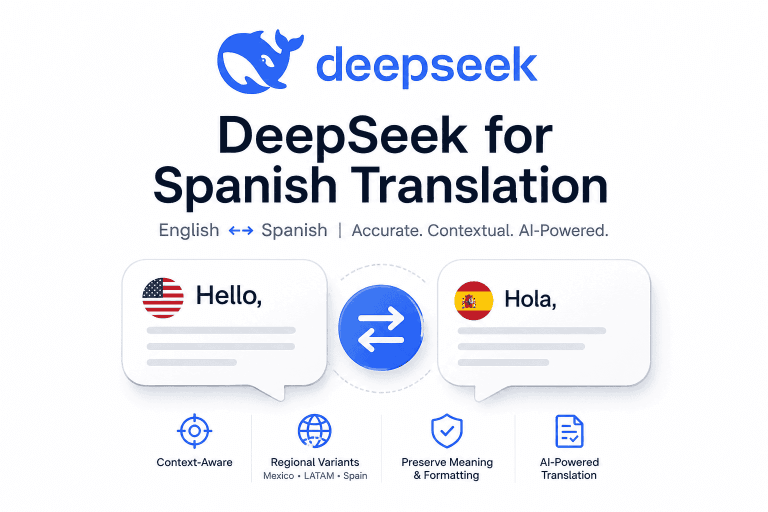
- 对比墨西哥西语、拉美西语和西班牙本土西语的不同表达
它还能很好地执行细致的翻译指令,比如保留 Markdown、不翻译占位符、按术语表统一用词、统一用 usted 而不是 tú,或者在不确定的地方打标注。这一点比“傻瓜式一键翻译”工具灵活很多。
不过话说回来,灵活也意味着风险:如果你不给清楚的受众、语气和地区说明,DeepSeek 可能会做出听起来很自信、但对你市场并不合适的选择。
准确率的真正风险点
很少有一个“DeepSeek 翻译准确率 = X%”这种万能数字。准确与否,取决于语言方向、主题、模型版本、提示词质量,以及你用什么标准来评估。Custom.MT 的那组 89.84% 和 100% 数据,只能当作一个参考样本,而不是官方标杆。
更有用的认知增量是:
真正的大坑,不是语法错误,而是“看起来很顺的西班牙语,却悄悄改了意思”。
比如把强烈的警告翻成温和建议,把“必须”弱化成“可以考虑”,或者在法律条款里多加了一点“人情味”。这些地方,机器不会主动告诉你它改了什么。
英译西:如何让 DeepSeek 更靠谱
什么时候适合用 DeepSeek 英译西
用 DeepSeek 做英译西时,最关键的一点是:你得先告诉它“要翻给谁看”。西班牙语不是一个统一市场,给墨西哥 SaaS 用户的落地页,和给西班牙公共机构的说明文,词汇和语气完全不一样。
英译西时,DeepSeek 在这些情况下更给力:
- 英文原文句子清晰、标点规范
- 少用模糊的俚语和双关
- 你能提供目标国家/地区、受众和语气
- 有简单的术语表可供参考
我自己在做产品文案时,会先用 DeepSeek 起一版墨西哥西语草稿,再请当地同事挑错。几轮下来发现:它在按钮文案、功能说明上基本靠谱,但在标语和品牌故事上,经常需要“重写而不是修补”。
西译英:理解为主,不要盲信
DeepSeek 的西译英很适合用来读懂西班牙语信息、做英文摘要或初步审阅文件,比如:
- 客户用西班牙语写来的邮件
- 评论、问卷开放题回答
- 内部调研材料
- 新闻或文章的英文概要
- 非正式聊天记录
- 学习资料
- 工单分流和优先级判断
但一旦原文里有俚语、地区表达、法律措辞、反话或缺失上下文,它就容易翻车。比如 “ahorita lo hago”,在不同国家可能是“马上做”“一会儿做”甚至“有空再说”。
用于商务场景时,可以在提示词里要求:遇到这类表达,宁可标注“可能含义 A/B/C”,也不要自作主张选一个看起来最顺眼的译法。
西语变体:墨西哥、拉美、西班牙,差在哪儿?
为什么“只说西班牙语”太模糊
很多人搜“DeepSeek 翻译西班牙语”,心里想的是“反正就是西班牙语”。但对真实用户来说,这个说法太粗糙了。西班牙语会因国家、地区、受众、行业和正式程度而变化。
RAE/ASALE 的《Diccionario panhispánico de dudas》就强调:它解决用法疑问时,会尊重整个西语世界的变体差异。比如:
- vosotros:在西班牙大部分地区用作非正式复数“你们”,在美洲基本不用;
- 很多南部西班牙地区(如加那利群岛、西安达卢西亚)则用 ustedes 做复数称呼;
- usted 在西班牙和美洲的规范用法中,都是正式单数“您”。
提示词里要明确的关键信息
一个合格的 DeepSeek 翻译提示词,应该明确你要的是:
- 墨西哥西班牙语
- 中性拉美西班牙语
- 西班牙本土西班牙语
- 面向广泛受众的“中性西班牙语”
- 使用 usted 的正式语气
- 使用 tú 的亲切语气
- 在西班牙使用的复数 vosotros
- 在拉美使用的复数 ustedes
DeepSeek 墨西哥西班牙语提示词示例
Translate the following English text into natural Mexican Spanish for [audience]. Use a [tone] tone. Use tú or usted according to the audience and brand relationship; always use ustedes for plural “you.” Preserve formatting, links, placeholders, variables, product names, brand names, and code. Use this glossary: [glossary]. If a phrase could be interpreted in more than one way, flag it after the translation under “Notes.”
Text:
[paste text]
DeepSeek 拉美西班牙语提示词示例
Translate the following English text into neutral Latin American Spanish for [audience]. Avoid vocabulary that is strongly specific to Spain unless it is the best technical term. Use ustedes for plural “you.” Preserve formatting, links, placeholders, variables, product names, brand names, and code. Use this glossary: [glossary]. Flag any phrase that may need country-specific localization.
Text:
[paste text]
DeepSeek 西班牙本土西语提示词示例
Translate the following English text into natural Spanish for Spain for [audience]. Use Spain-appropriate vocabulary and use vosotros for informal plural “you” when appropriate. Preserve formatting, links, placeholders, variables, product names, brand names, and code. Use this glossary: [glossary]. Flag any phrase that may sound too Latin American or too literal.
Text:
[paste text]
常见翻译错误:哪些坑要提前盯紧
AI 翻译里最典型的错误类型
DeepSeek 的常见错误,其实和其他机器翻译差不多,你需要特别留意:
- 成语和固定搭配直译
比如 “break the ice” 不能按字面翻成“打破冰块”。 - 假朋友词(false friends)
长得像的词,意思可能完全不一样。 - 敬语和亲密度用错
该用 usted 的场合用了 tú,或者品牌需要亲切语气却被翻得过于正式。 - 地区词汇不匹配
西班牙常用词放到墨西哥会显得奇怪,反之亦然。 - 性数配合错误
尤其是有变量、占位符或拼接句子时容易乱套。 - 意思被弱化或丢失
严厉的警告被翻成温和建议,强制要求被翻成“可以考虑”。 - 语言过于僵硬
在商务、技术和客服内容里尤其明显,看着就不像人写的。 - 术语不统一
“account”“profile”“workspace”“dashboard”前后翻法不一致。 - 不该翻的东西被翻了
品牌名、URL、代码、变量、SKU、占位符等被误改。 - 格式被破坏
Markdown、HTML 标签、换行、表格、编号步骤被打乱。 - 高风险领域细节缺失
法律、医疗、技术细节被简化或误解,这是最危险的一类。
提示词如何提升翻译准确度
一句“Translate this to Spanish.” 是典型弱提示词:
Translate this to Spanish.
更强的版本会长这样:
Translate English to Mexican Spanish for small business owners in a friendly but professional tone. Use usted for direct address. Preserve Markdown, links, product names, placeholders, and variables. Use the glossary below. Flag phrases that may be ambiguous.
可以套用这个通用公式:
Translate [source language] to [target variant] for [audience] in a [tone] tone. Preserve [items]. Use this glossary: [glossary]. Flag uncertain phrases. Return [output format].
人类译者接活时,都会先问:给谁看、什么语气、什么国家、有没有术语表、哪些东西不能动。你在提示词里把这些说清楚,DeepSeek 的翻译质量会有明显提升。
顺带一提,DeepSeek V4 模型默认开启“思考模式”,可以把 reasoning_content 和最终 content 分开返回。做普通翻译时,一般只需要最终译文,不要解释过程。Custom.MT 的评测提示词里,也特别强调了“保留格式,只输出翻译”。
10 组可直接复制的西班牙语翻译提示词
1. 通用英译西提示词
Translate the following English text into [Mexican Spanish / neutral Latin American Spanish / Spain Spanish] for [audience].

Tone: [friendly / professional / formal / casual / persuasive]
Formality: Use [tú / usted / ustedes / vosotros] where appropriate.
Domain/context: [briefly explain the topic]
Glossary:
- [English term] = [Spanish term]
- [English term] = [Spanish term]

Requirements:
- Preserve formatting, headings, bullet points, Markdown, links, numbers, dates, and line breaks.
- Do not translate brand names, product names, URLs, email addresses, code, variables, placeholders, or text inside brackets unless instructed.
- Flag uncertain phrases or terms after the translation under “Notes.”
- Return only the translation and notes.

Text:
[paste text]
2. 西译英提示词
Translate the following Spanish text into natural English for [audience].

Source variant if known: [Mexico / Latin America / Spain / unknown]
Tone: Preserve the original tone as closely as possible.
Domain/context: [brief context]

Requirements:
- Preserve formatting, links, names, numbers, dates, and placeholders.
- Do not translate brand names, URLs, variables, code, or product names.
- If the Spanish contains slang, idioms, or region-specific wording, explain the possible meaning under “Notes.”
- If a phrase is ambiguous, flag it instead of guessing silently.

Text:
[paste text]
3. 墨西哥西班牙语专用提示词
Translate this English text into natural Mexican Spanish.

Audience: [audience]
Tone: [tone]
Formality: Use [usted / tú] consistently.
Domain/context: [context]
Glossary:
[add terms]

Requirements:
- Use vocabulary natural for Mexico.
- Avoid Spain-specific terms unless they are standard technical terms.
- Preserve formatting, URLs, placeholders, variables, code, and brand names.
- Flag any phrase that may need legal, technical, or cultural review.

Text:
[paste text]
4. 拉美中性西班牙语提示词
Translate this English text into neutral Latin American Spanish.

Audience: [audience]
Tone: [tone]
Formality: Use ustedes for plural “you.”
Domain/context: [context]
Glossary:
[add terms]

Requirements:
- Keep the Spanish broadly understandable across Latin America.
- Avoid country-specific slang.
- Do not use Spain-specific vosotros forms.
- Preserve formatting, URLs, placeholders, variables, code, and brand names.
- Flag terms that may need country-specific localization.

Text:
[paste text]
5. 西班牙本土西语提示词
Translate this English text into natural Spanish for Spain.

Audience: [audience]
Tone: [tone]
Formality: Use [tú / usted] for singular address and [vosotros / ustedes] according to the intended formality.
Domain/context: [context]
Glossary:
[add terms]

Requirements:
- Use vocabulary natural for Spain.
- Avoid Latin American regional wording unless required by the source.
- Preserve formatting, URLs, placeholders, variables, code, and brand names.
- Flag any phrase that may sound too literal or too region-specific.

Text:
[paste text]
6. 商务邮件翻译提示词
Translate this business email from English to [target Spanish variant].

Audience: [client / partner / internal team / prospect]
Tone: professional, clear, and polite.
Formality: Use [usted / ustedes] unless the email is clearly informal.
Domain/context: [context]
Glossary:
[add terms]

Requirements:
- Keep the greeting and closing natural in Spanish.
- Preserve names, company names, job titles, dates, times, links, and attachments.
- Do not make the message more forceful or more apologetic than the source.
- Flag any sentence where the intended tone is unclear.

Email:
[paste text]
7. 网站与落地页翻译提示词
Translate this website copy from English to [target Spanish variant].

Audience: [audience]
Brand voice: [brief voice description]
Tone: persuasive but natural, not exaggerated.
Formality: [tú / usted / neutral]
Domain/context: [product/service]
Glossary:
[add terms]

Requirements:
- Preserve headings, CTAs, buttons, Markdown/HTML, links, placeholders, and variables.
- Do not translate brand names, product names, URLs, tracking parameters, or code.
- Adapt the copy so it sounds natural in Spanish, but do not add claims not present in the source.
- Flag any slogan, idiom, or CTA that needs transcreation rather than direct translation.

Copy:
[paste text]
8. 客服回复翻译提示词
Translate this customer support response from English to [target Spanish variant].

Audience: customer
Tone: helpful, calm, and clear.
Formality: Use [usted / tú] consistently.
Domain/context: [software / ecommerce / billing / technical issue]
Glossary:
[add terms]

Requirements:
- Preserve step numbers, UI labels, links, product names, and placeholders.
- Do not translate UI labels unless the glossary provides approved translations.
- Keep instructions simple and unambiguous.
- Flag any safety, billing, legal, or account-access wording that should be reviewed.

Response:
[paste text]
9. 技术文档翻译提示词
Translate this technical documentation from English to [target Spanish variant].

Audience: [developers / admins / end users / technical support]
Tone: precise, clear, and concise.
Formality: neutral professional.
Domain/context: [technical context]
Glossary:
[add terms]

Requirements:
- Preserve Markdown, code blocks, inline code, commands, variables, placeholders, API parameters, URLs, file paths, and screenshots references.
- Do not translate code, function names, product names, CLI commands, or configuration keys.
- Keep terminology consistent throughout.
- Flag any ambiguous technical term or sentence that could affect implementation.

Documentation:
[paste text]
10. 译文质检 / 后编辑提示词
Act as a professional Spanish translation reviewer.

Compare the source text and the Spanish translation below. Check for:
- Meaning shifts
- Omissions
- Additions
- Regional mismatch
- Tone mismatch
- Terminology inconsistency
- Formatting damage
- False friends
- High-risk phrases
- Incorrect formality, including tú/usted/ustedes/vosotros
- Incorrect translation of names, URLs, variables, placeholders, code, or brand terms

Target variant: [Mexican Spanish / neutral Latin American Spanish / Spain Spanish]
Audience: [audience]
Domain/context: [context]
Glossary:
[add terms]

Return:
1. Overall risk level: Low / Medium / High
2. Issues found in a table
3. Suggested corrected translation
4. Notes for human review

Source:
[paste source]

Translation:
[paste translation]
什么时候不要只靠 DeepSeek
高风险内容必须有人兜底
只要翻译结果可能影响权利、健康、金钱、合规、安全或公众形象,就不该只依赖 DeepSeek。更稳妥的做法是:让它帮你起草、对齐术语、发现问题,再由专业译者或双语专家做最终把关。
建议务必有人审校的内容包括:
- 各类法律合同
- 法院文件
- 移民材料
- 需要盖章的认证翻译
- 医疗说明和用药指导
- 药品相关内容
- 保险与金融文件
- 安全警示
- 劳动与雇佣文件
- 监管申报材料
- 公共品牌营销活动
- 高流量落地页
- 任何一旦翻错会伤人或伤公司的内容
美国翻译协会(ATA)就明确表示:机器翻译只是译者工具箱里的一个工具,如果需要可靠且安全的翻译,就不能在没有专业译者持续参与的情况下单独使用机器翻译。ISO 18587 也专门规定了机器翻译后“完全人工后编辑”的要求和后编辑人员的能力标准。
更安全的心态是:
用 DeepSeek 来加速翻译流程,而不是用它来“替你负责”。
和其他 AI 翻译工具怎么搭配
在 DeepSeek、Google Translate、DeepL、ChatGPT 和人工译者之间,其实没有一个“永远最强”。真正影响选择的,是内容类型、语言方向、风险等级、保密要求、术语控制能力,以及你能投入多少审校资源。
做商业本地化时,更靠谱的流程往往不是“DeepSeek vs DeepL vs Google Translate”,而是:
- 用 AI 西班牙语翻译起草初稿;
- 用术语表强制统一关键词;
- 人工检查意思和语气;
- 针对目标市场做本地化微调;
- 高风险内容交给合格译者最终批准。
Google Cloud Translation 自带术语表功能,可以在特定领域保持用词一致。DeepSeek 虽然没有内置术语表系统,但可以通过提示词模拟类似流程,只是用户需要更主动地核对结果。我也不太确定哪种方式对所有团队都更高效,这可能得结合你们现有工具链来试一试。
发布前的 DeepSeek 西班牙语翻译检查清单
在你点击“发送”或“上线”之前,至少过一遍下面这些问题:
- 目标变体写清楚了吗:墨西哥、拉美、西班牙,还是其他国家?
- 敬语选择对吗:tú、usted、ustedes、vosotros?
- 有没有提供术语表或关键词说明?
- DeepSeek 是否完整保留了人名、链接、变量、占位符和代码?
- 原文的意思有没有被删减或擅自添加?
- 成语、俚语有没有被直译?
- 地区词汇是否符合目标市场?
- 格式(Markdown/HTML、列表、编号)有没有被破坏?
- 语气是否符合品牌和场景?
- 如果是公开、法律、医疗、金融或高风险内容,有没有人审过?
- UI 文案或落地页有没有在真实界面里预览过?
- 提示词里有没有要求 DeepSeek 标注不确定之处,而不是“装作很确定”?
一个成熟的 DeepSeek 翻译流程,不是“翻完就发”,而是:翻译 → 检查 → 本地化 → 审批。
小结与行动建议
如果你愿意多花 30 秒写清楚受众、语气、地区和术语,DeepSeek 可以成为非常好用的西班牙语翻译“加速器”。它在英译西草稿、西译英理解、以及墨西哥/拉美/西班牙等地区版本上,都能帮你省下不少机械劳动。
真正拉开差距的,不是你用不用 AI,而是你有没有建立一套“提示词 + 术语表 + 人工审校”的组合拳。那套判断翻译是否可靠的清单,你可以反复拿出来用,也很适合转给团队同事一起对齐标准。
如果你正纠结要不要把 DeepSeek 接入翻译流程,这篇内容往往比问身边人“你觉得靠谱吗?”更有参考价值。
常见问题
Q:DeepSeek 做西班牙语翻译到底靠不靠谱?
A:DeepSeek 在低到中风险内容上的西班牙语翻译是可用的,前提是你给出足够具体的提示词。它适合做草稿、内部文档、邮件、客服回复、学习辅助和首轮本地化,不适合单独承担法律、医疗、认证、金融或其他高风险内容。原因在于,它擅长生成流畅文本,却难以保证每个细节都符合当地法律和行业规范。建议做法是:用 DeepSeek 起稿和对齐术语,再由懂西语和业务的人做最终审校,尤其是对外发布前。
Q:怎么让 DeepSeek 把英文准确翻成西班牙语?
A:要提高英译西的准确度,关键是提示词要具体:写清楚目标变体(如墨西哥西语、中性拉美西语、西班牙本土西语)、受众、语气、敬语(tú/usted/ustedes/vosotros)、领域背景和术语表。这样模型才能在词汇选择和语气上更贴近真实场景。操作上,可以直接套用文中的通用提示词公式,并在高风险内容中要求它标注不确定的地方,方便你后续重点检查,而不是盲目相信一版就过。
Q:DeepSeek 翻西班牙语成英文时,有哪些坑要注意?
A:西译英时,DeepSeek 容易在俚语、地区表达、法律措辞和反讽语气上出问题。比如同一句“ahorita lo hago”,在不同国家语气差别很大,如果模型强行选一个含义,就可能误导你。更稳妥的做法是:在提示词里要求它遇到俚语或地区用法时,列出可能含义并放在“Notes”里,而不是悄悄做决定。对涉及合同、政策或投诉的内容,务必让懂西语的人复核,尤其是关键条款和时间、金额等细节。
Q:DeepSeek 生成的墨西哥西班牙语能直接用在市场活动里吗?
A:DeepSeek 可以在你明确要求的情况下生成墨西哥西班牙语,但直接用于市场活动仍有风险。准确度取决于原文清晰度、提示词、术语表和你对品牌语气的控制。营销内容往往需要更强的本地化和创意改写,而不是直译。建议做法是:先用 DeepSeek 生成墨西哥版本草稿,再由当地市场或本地译者调整用词和语气,特别是标语、CTA 和文化敏感点,避免出现“听得懂但不地道”的尴尬效果。
Q:我想让 DeepSeek 用拉美或西班牙本土西语,提示词要怎么写?
A:如果要拉美西语,可以在提示词中写“neutral Latin American Spanish”,要求使用 ustedes 作为复数“你们”,避免西班牙特有词汇,并让模型标注可能需要按国家微调的词。要西班牙本土西语,则写“Spanish for Spain”,要求使用当地常用词,并在非正式复数场景下用 vosotros。原因是两大地区在称呼、日常词汇和语气上差异明显。实操上,可以直接复制文中的对应提示词模板,再结合你的受众和品牌语气做小幅调整。